Chapter 01
A family across the water
The history of this McFaul family comes into its clearest focus in the farms and settlements of Argenteuil, Quebec. There, a family remembered as having come from County Antrim put down roots that would reach into Ontario, the American Midwest, the Pacific Northwest and British Columbia. The surviving accounts give us more than names. They preserve a farm passed through a granddaughter, brothers leaving agriculture for a shop in Lachute, a woman whose travels took her to Italy and Switzerland, and an elderly McFaul whose prayer was remembered long after the cold evening on which it was spoken. [1] [2]
This first research edition follows the family represented in the comrade28 Geneanet tree supplied by Brian McFaul. It is a history of that tree’s principal early Canadian branches, rather than a claim that every person named McFaul shares one documented ancestor. Brian’s exact descent through the later generations has not yet been established in this research. Living relatives are therefore outside the published narrative. Dates taken only from the online tree are identified as such, and the more doubtful connections are retained as questions rather than quietly promoted into facts. [1]
The most valuable independent narrative found is Cyrus Thomas’s 1896 History of the counties of Argenteuil, Que., and Prescott, Ont. Writing while several of the people he described were still alive, Thomas connected the McFaul merchants of Lachute with an immigrant great-grandfather from Antrim. His account is especially useful for the family’s nineteenth-century relationships and work. It remains a local history, not an original immigration document, and its recollections of the earliest generation must be tested against church, land and civil records. [2]
Read this history as a carefully marked path. Some stretches are supported by a contemporary account; others follow a later family recollection; at the oldest end, several bridges are still missing. A worthwhile family history can hold all three without confusing them. The intention is to recover these people as faithfully as the evidence allows, and to leave a clearer trail for the next person who opens the records.
Chapter 02
The name, and the question of Scotland
McFaul belongs to a group of surnames associated with Gaelic forms meaning “son of Paul.” The surname reference reproduced by Geneanet from the Dictionary of American Family Names describes McFaul as a Northern Irish variant of McPhail, while also allowing another Irish derivation through Lavelle. This is a warning against treating an explanation of a name as a pedigree. An etymology tells us how a surname may have developed; it does not identify the parents of a particular person. [3]
Within the supplied tree itself, the spellings McFaul, McFall and McPhail appear among related Canadian branches. William George’s children include people entered as McFall, while Matthew’s descendants are commonly entered as McPhail. These are practical search clues. A record should not be rejected simply because a clerk wrote a different vowel or ending; equally, matching spellings do not make two people identical. Names need to travel with dates, spouses, occupations, residences and neighbours. [10] [12]
Scottish ancestry has a definite place in the family’s remembered past, but its exact documentary foundation is unsettled. The immigrant Archibald’s Geneanet notes include both an Antrim birth and an account placing his birth in the Scottish Highlands before a move to Ireland. Another passage attributes an Irish birth to research preserved through John T. Forde, while retaining Scottish ancestry as tradition. Thomas’s independent account says that the immigrant came from County Antrim; it does not establish an earlier Scottish birthplace or Scottish parents. [4] [2]
The tree proposes an older Archibald McPhail baptised on Jura on 22 August 1714, the son of Duncan McPhail and Catharin McArthur, as the father of Andrew McFaul in Antrim. That Scottish baptism is presently an indexed claim in a compiled profile. Even if the original baptism confirms every detail, a separate piece of evidence is still needed to connect that child to the later Irish household. A shared forename and a compatible surname are a starting point, not the missing migration record. [8]
Clan MacPhail’s own surname material includes McFaul among associated spellings. Such associations can be meaningful cultural context, but they should not be used to assign this family a particular chief, medieval ancestor or entitlement to arms. No documentary chain establishing those claims for this branch was found in this research. The family’s nineteenth-century Canadian story is substantial enough to stand on its own, without a borrowed medieval pedigree. [22]
Chapter 03
Antrim: an older foothold in the records
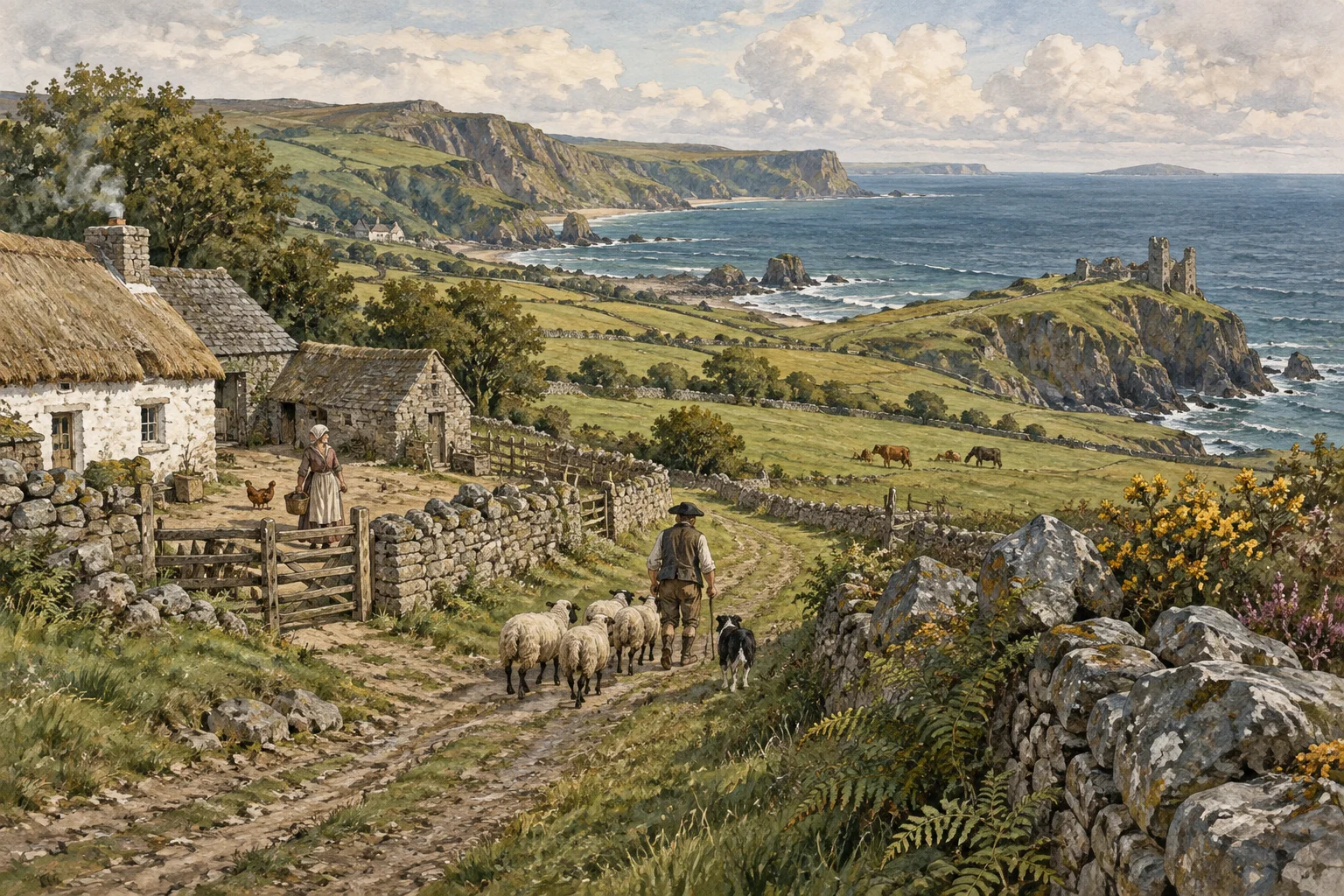
The most promising early Irish lead is an Andrew McFaul in a transcription of the 1766 religious census for Ballintoy parish, County Antrim. W. Macafee’s transcription, identifying the underlying PRONI reference as T3901/2, lists Andrew under the original spelling m’Faul at Glenstaghey, with Glenstaghie supplied in brackets. It records him as Protestant. The entry appears on page 8 of the transcription and points to page 1 of the original document. [5]
That combination of forename, surname and townland is significant because the supplied tree places an Andrew McFaul, born about 1743, at Glenstaghie, Ballintoy. It gives him a wife Elizabeth and a son Dennis. The census transcription strengthens the case that a man of the right name was actually present in the locality during the proposed generation. It does not give Andrew’s age, wife, birthplace or children, and therefore does not prove that he was Dennis’s father. The finding deserves careful follow-up precisely because it is specific enough to test. [5] [6]
Two research habits matter here. First, the original spelling should remain alongside the modernised one. A future search confined to McFaul could miss m’Faul or McPhail. Second, the original document should be consulted before drawing conclusions from the transcription alone. The next useful evidence would connect the named man to a household, lease, estate, church entry or later relative. Repeating the same unsourced family tree across several websites would not provide that connection.
The tree’s proposed intervening generation is Dennis McFaul, born about 1768 in the Ballintoy area, and Catharine Bergin, born about 1767. A British regimental-register reference attached to Dennis points to WO 25/499 and the 84th Foot, with a date of 1 May 1794. This is a concrete archival lead, but the original entry has not been inspected. Until its birthplace, age and service details are compared with other records, it cannot establish either Dennis’s identity or his relationship to the Canadian immigrant. It certainly cannot be transferred to Archibald as proof of Archibald’s own military service. [7] [25]
There are reasons to be particularly cautious about the proposed Dennis–Catharine household. The attached Irish Catholic register references include Offerlane, Rathdowney and Aghaboe in County Laois, far from the Antrim locality proposed for Dennis. Migration could explain a geographical change, but no connecting evidence was found. The profiles also contain late child dates that would put Catharine at roughly fifty-nine or sixty-six. These may be bad dates or attached records belonging to another woman. Either way, the existing combination cannot safely carry the pedigree further back. [7] [9] [16] [17] [18]
For now, Andrew of the 1766 transcription is a promising person to investigate, Dennis’s army reference is a useful record to retrieve, and the Scottish connection remains unproved. Keeping those statements separate protects the best evidence from the weakest parts of the compilation.
Chapter 04
Archibald and Margaret: the Canadian beginning
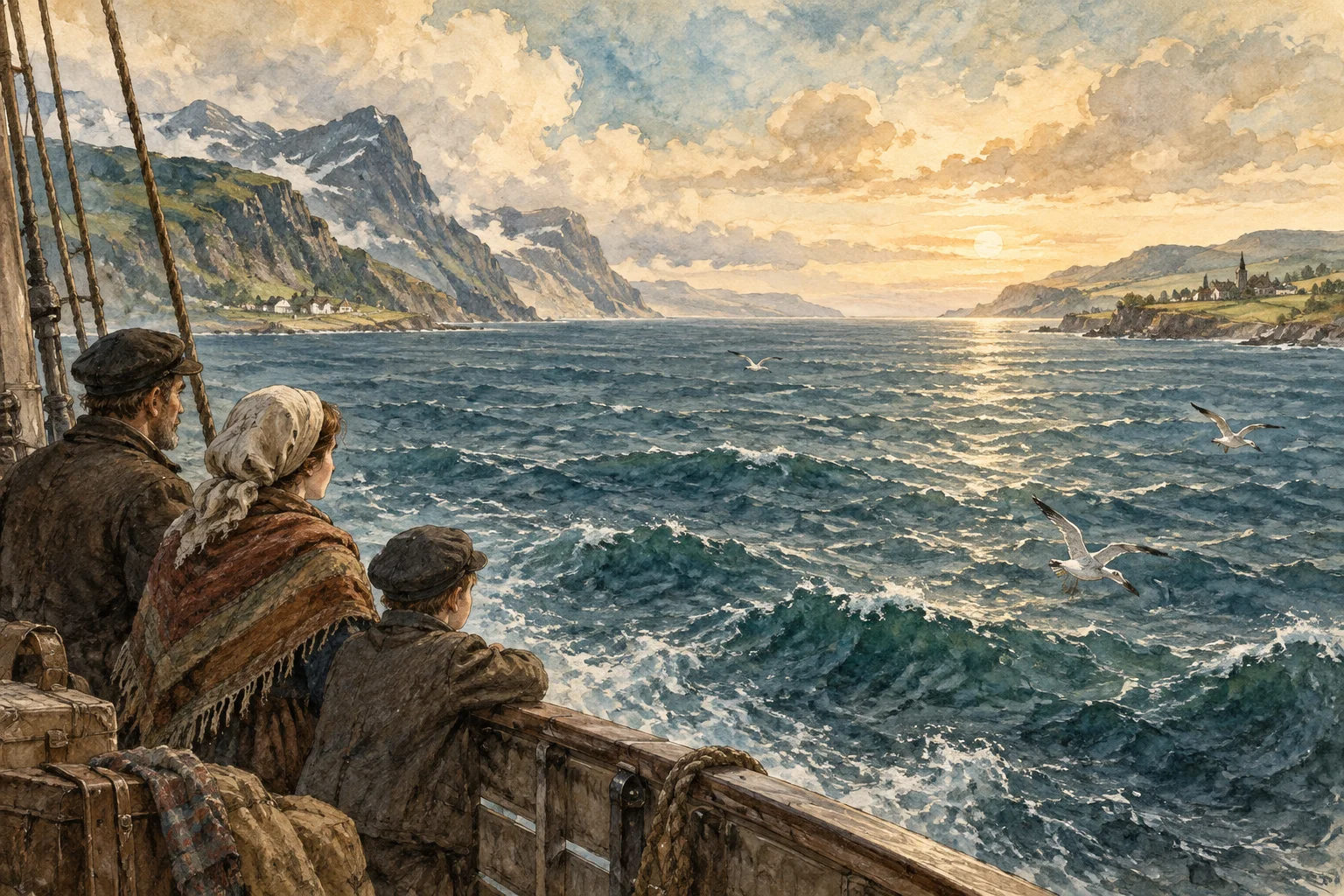
Across the Atlantic
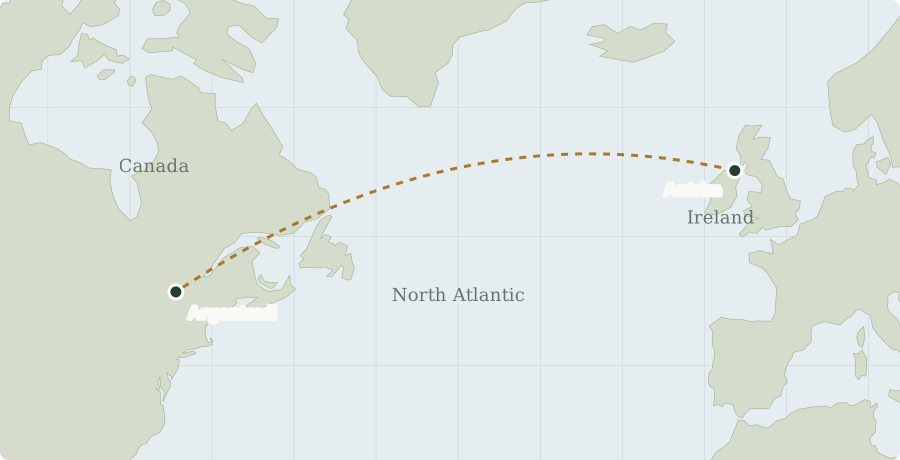
At the centre of the Canadian story stands the man entered in the supplied tree as Archibald Floyd McFaul. That profile gives his birth as October 1786 in Antrim and his death as 8 October 1866 in Ontario. The independent 1896 history calls him simply Archibald McFaul. The middle name Floyd and the precise birth and death dates therefore remain tree-level details in this edition. Thomas supplies a firmer geographical outline: Archibald came from County Antrim, settled in Chatham, and eventually died at his son William’s home in Wallace, Ontario. [4] [2]
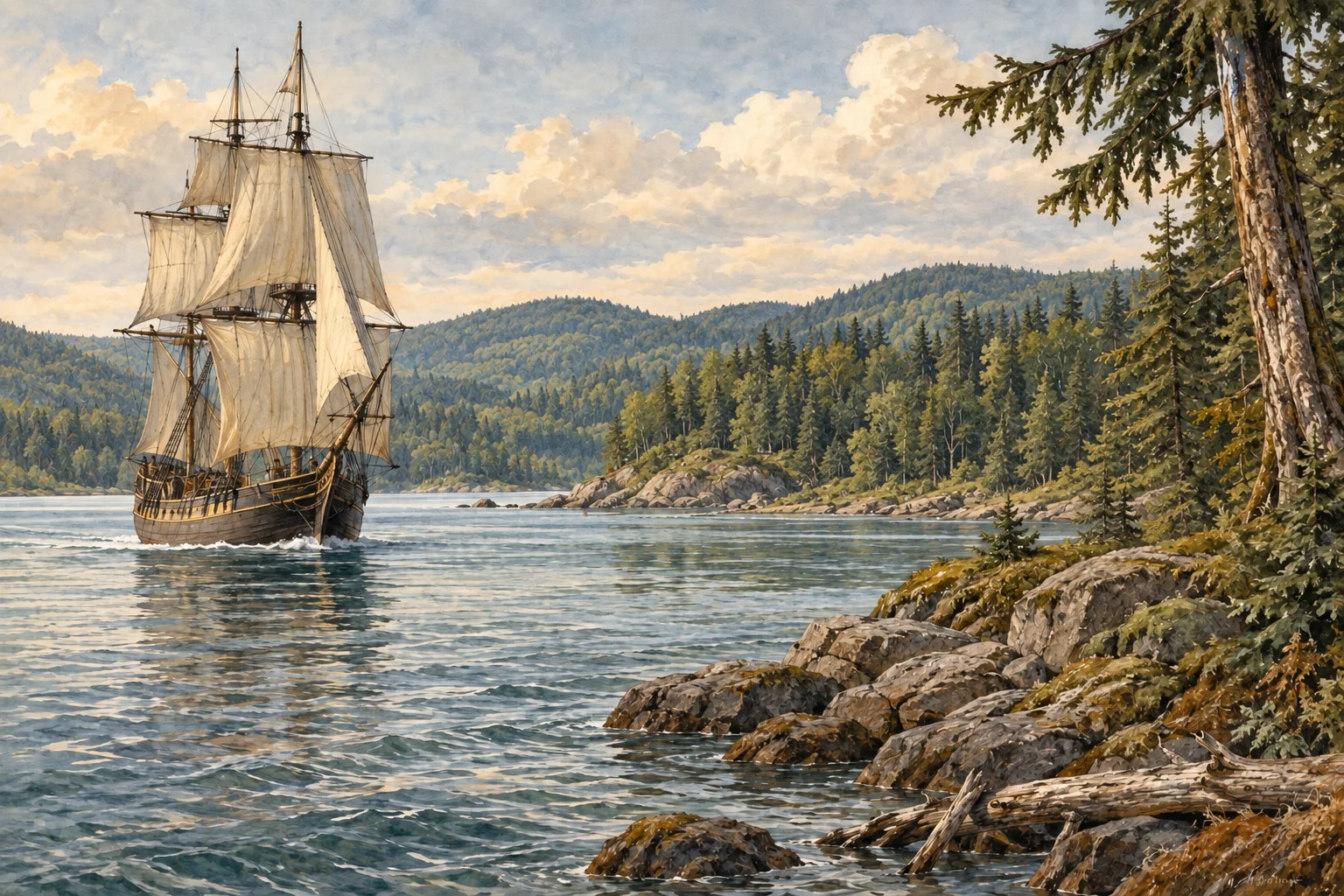
The family research notes reproduced on Geneanet place his arrival in Canada in 1818, accompanied by Margaret Finley or Finlay and five children: two boys and three girls, all born in Ireland. Two further sons, James and Matthew, were subsequently born in Canada. Thomas’s account of four sons and three daughters is compatible with that seven-child outline, although it gives no arrival year. Together these accounts offer a coherent working reconstruction; neither supplies the original passenger record or a named ship. [4] [2]
There is an important complication. The present profile links eleven children to the immigrant, including overlapping Archibalds and Jameses and additional McFall entries. This differs from both the seven-child account in the family notes and Thomas’s count. Some entries may represent duplication, mistaken attachment or a distinction not explained in the material examined. The four sons discussed in this history—Archibald, William, James and Matthew—fit the narrative outline, but the complete sibling group should not be treated as settled. [4]
An arrival in 1818 also changes the historical setting. If that family date is correct, this was a migration well before the Great Famine. It should not be described as an escape from the famine of the 1840s. The records examined do not reveal the couple’s precise motive for leaving, their port of departure, the vessel, the Atlantic crossing, or their first Canadian landing place. A vivid account of those events would be fiction at present, however familiar the general emigrant story may sound.
The regional waterways were changing around the time of their settlement. Parks Canada dates the first Ottawa River canal works in this area to 1819–1833 and describes the importance of the timber trade. This offers context for the country in which the family established itself. It does not demonstrate how the McFauls travelled, and the family should not be pictured arriving in 1818 by a completed canal that did not yet exist. Nor does the regional timber economy by itself prove that Archibald worked as a lumberman. [19]
Margaret is essential to this beginning, even though the surviving narrative gives her much less space. Her profile places her death at Dalesville on 21 May 1841. The tree’s approximate marriage date of 1800 would make both spouses about fourteen if their stated 1786 births are correct. That combination needs verification. Another marriage entry attached to her concerns an Archibald McDonell and must not be accepted as part of this couple’s life without an identity check. The safest present account names Margaret as the wife in the family’s migration tradition and identifies the precise dates as still requiring original records. [15] [4]
The same distinction applies to stories of a military pension and land grant. Family notes preserve such a tradition, and the profile cites a Quebec land-grant index. No original grant or service record establishing the story has yet been examined. The useful next step is unusually clear: retrieve Letters Patent Book W, Grants, page 75, and the county index reference, volume 1, page 38, then compare the beneficiary, township and legal description with the family’s later land. That could turn an inherited explanation into a documented one. [4] [24]
Chapter 05
Making a home in Chatham
The Ottawa Valley homeland
Here, Chatham means the historical township in Argenteuil, Quebec—not Chatham in southwestern Ontario. The family’s early Canadian places form a regional cluster around Dalesville, Brownsburg, Lachute and the Ottawa River settlements. Keeping that geography straight matters: a search for the wrong Chatham could produce an impressively detailed history of an entirely different family.
The family notes report that James, born in 1820, and Matthew, born in 1822, were baptised together on 22 September 1822 by the Reverend Archibald Henderson, with their parents described as residents of Chatham. The original register has not been examined for this edition. If confirmed, it would provide an early dated record of the household in Canada and connect the parents to two children born after the proposed migration. It is therefore one of the highest-priority documents to obtain. [4]
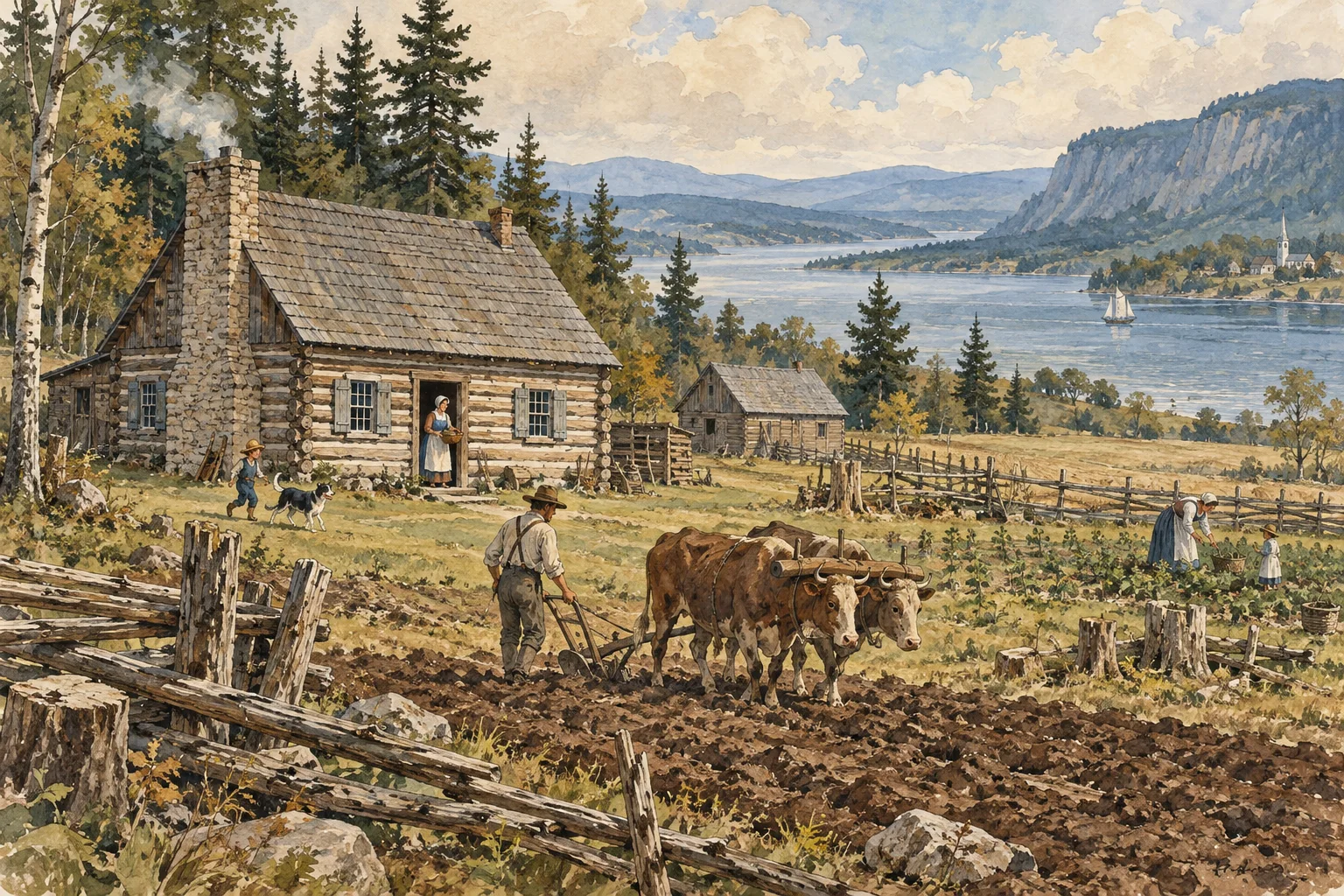
Thomas describes the immigrant’s farm through its later occupant: his granddaughter, Mrs. Hugh Morrow. This is a valuable way of following a family through land. Instead of an isolated ancestor disappearing after a date of death, we see a property passing into the next generations and a married daughter’s family carrying its story forward. Thomas says Archibald lived there for many years before dying at William’s home in Ontario. The Canadian beginning thus had two geographical endings: the old homestead remained in Quebec, while the elderly immigrant’s final home was with a son farther west. [2]
Land should be investigated as a sequence, not as a single lucky discovery. A grant, a purchase, an inheritance and a later sale can each describe the same property while naming different family members. The useful questions are who first held it, when a spouse’s rights were recorded, which heirs had interests, and how those interests were consolidated. Thomas’s reference to the Morrow occupation gives a destination for that search, but it does not supply all the legal transactions in between.
The place-name McFaul’s Flats also appears in Thomas’s history. He describes land purchased by Murdoch Graham in 1887 in the tenth range of Chatham as lying in the area known by that name. It is a small but memorable sign that the surname had entered local geographical usage by the late nineteenth century. It does not, on its own, prove the boundaries of the immigrant’s original holding or identify which McFaul first gave the district its name. [2]
The family notes preserve another kind of inheritance: a story of Archibald’s damaged leg, its later amputation, and a wooden replacement he made for himself. These details belong to the oral-history strand transmitted in the tree. They have not been independently corroborated, and the colourful episodes surrounding them should not be narrated as witnessed fact. Yet the existence of the story is itself part of the family’s memory: descendants remembered a particular, physically recognisable man, not merely a name on a chart. [4]
Chapter 06
Faith in a cold chapel
One of the most human passages in Thomas’s history comes from the recollections of the Reverend John King. Describing the religious life of the rear of Chatham, King remembered a population of Highland and Lowland Scots with some Protestant Irish. His account identifies many Highland settlers with Glenlyon in Perthshire. That is evidence about the community King encountered, rather than proof that the McFauls themselves came from Glenlyon. [2]
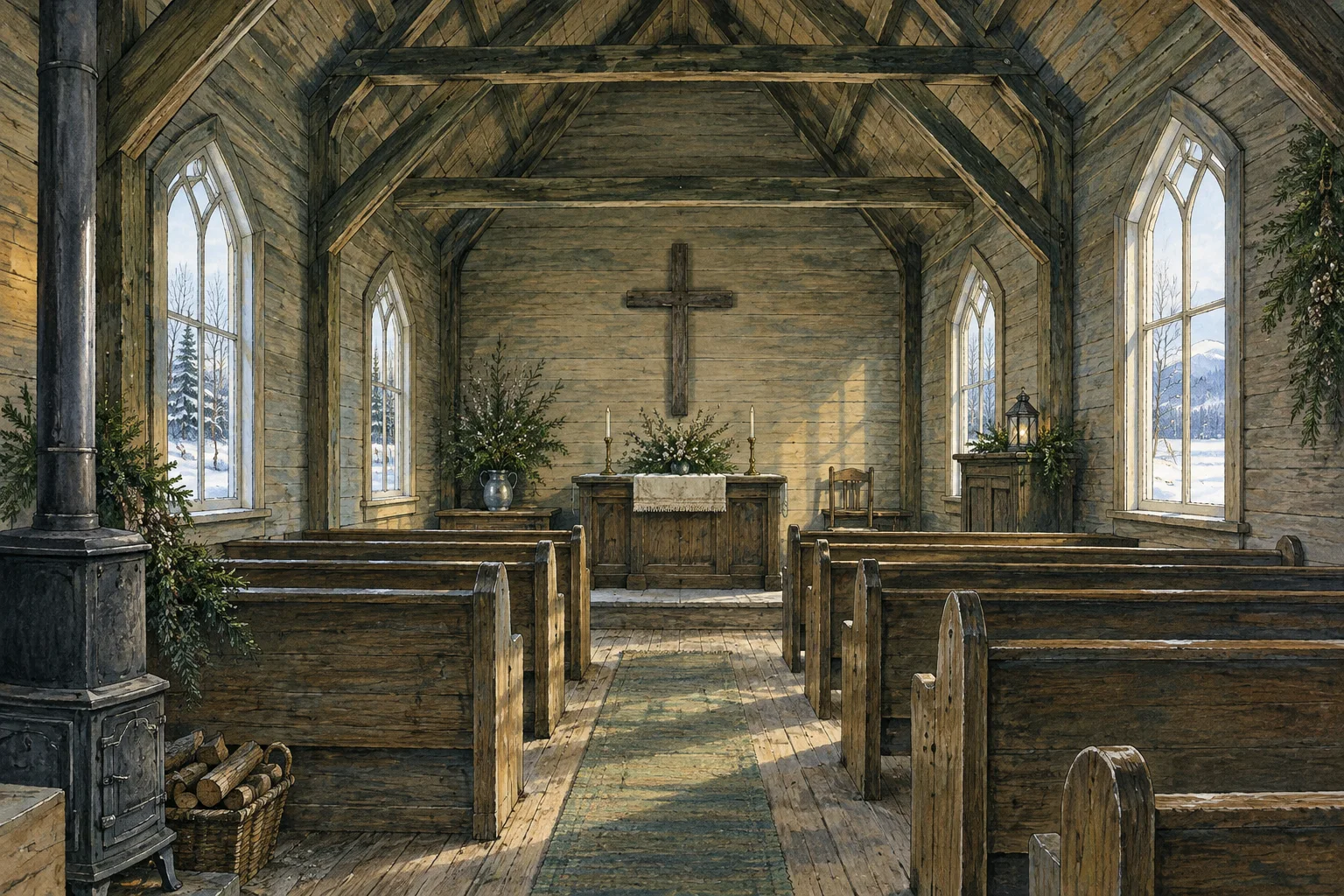
At a meeting in the settlement, King heard an elderly man named McFaul pray with an earnestness that encouraged him to announce another meeting for the following evening. The chapel was unfinished and cold. Its interior walls had not been plastered, green firewood sometimes would not burn, and the stove pipes leaked smoke. These details give the episode its force. The remembered act of faith happened in an uncomfortable working settlement, among people whose place of worship was still being made. [2]
King describes gatherings that continued for five weeks and resulted in fifty baptisms. The present Dalesville Baptist Church history places this second revival in 1843 and reproduces the remembered McFaul prayer. The church’s account is useful for its institutional chronology, but it follows the older narrative and should not be counted as a completely independent second witness to the event. [2] [20]
Was the elderly man the immigrant Archibald? He is a plausible candidate within the family’s chronology and locality, but King did not give the man’s forename in the passage examined. This edition therefore calls him an elderly McFaul, just as the source does. That small restraint matters. It allows us to retain a moving episode without attaching another person’s words to Archibald solely because the identification would make a satisfying story.
Nor should one episode turn the whole extended family into members of a single church for every generation. The supplied profiles cite different Protestant registers in Canada, and the doubtful Irish attachments include Catholic material. Church affiliation belongs to individuals, households and particular dates. The chapel story establishes a McFaul presence in one remembered religious moment; original membership, marriage, burial and baptism entries are needed to trace the wider family’s affiliations. [4] [10] [11]
Chapter 07
Archibald and Mary Carpenter: the rooted generation
The younger Archibald, distinguished as Archibald II in the supplied tree, links the immigrant generation to the McFaul merchants whom Thomas described. The tree places his birth in Ireland in 1808 and his marriage to Mary Carpenter on 21 February 1833 at St. Andrews Anglican Church. Thomas independently names Mary as a daughter of James Carpenter and gives her husband’s death as 12 February 1887. That agreement on the spouse’s family and the exact death date makes this one of the stronger intersections between the online compilation and the older local history. [11] [2]
Thomas says the couple lived on a Chatham farm and had six sons and four daughters who grew up. The tree’s displayed child list does not exactly reproduce that total. A family reconstruction should therefore start from the couple’s marriage and work through each child’s baptism, later marriage and burial. Children who died young, differently named entries and omitted daughters can all complicate a count. The discrepancy is a reason to examine the household more closely, not to choose whichever total makes a neater chart. [2] [11]
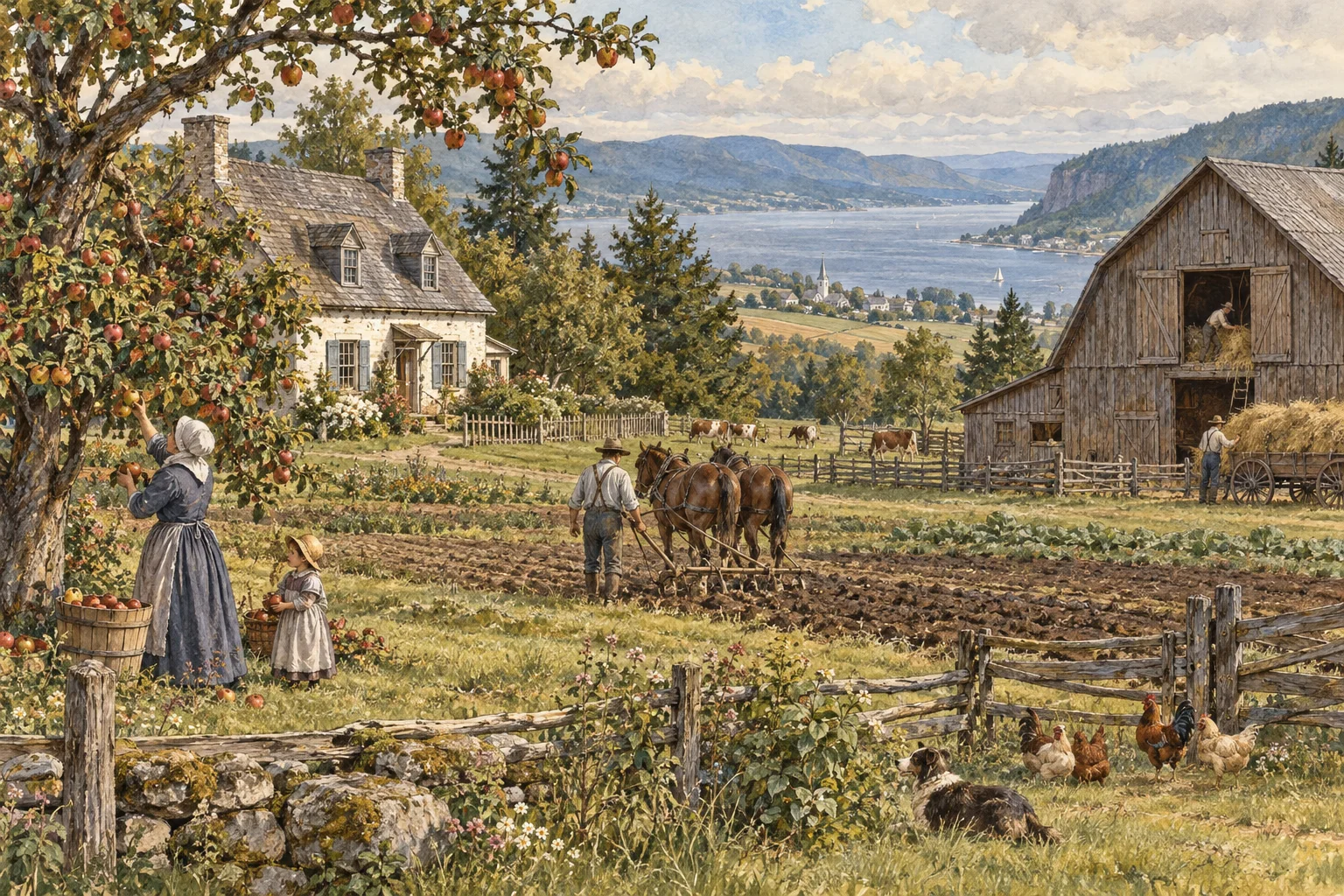
Their eldest son James forms the next link in Thomas’s commercial sketch. He married Janet McPhail about 1868, occupied a hundred-acre farm at Brownsburg, and subsequently bought three hundred adjoining acres. Thomas credited the couple with five sons and five daughters. Here, the author’s wording suggests a household whose agricultural base had expanded considerably by the time he wrote. It does not tell us the purchase prices, mortgages, yields or balance of labour, and those details should remain open until other records provide them. [2]
This branch presents a familiar trap for genealogists: repeated names in adjacent generations. The James who farmed at Brownsburg was the father of the merchant James C.; the elder and younger Archibalds were likewise different men. In this edition, II is an editorial aid inherited from the tree, not a claim that the man signed himself that way. Future documents should identify each person by spouse and residence as well as name. [2] [11]
The structure of this branch is nevertheless unusually well supplied by the 1896 account: immigrant Archibald; his son Archibald and Mary Carpenter; their son James and Janet McPhail; and the brothers James C. and John M. McFaul. It gives four generations in one passage. Because it was written for a local history rather than a modern genealogical database, it is a particularly useful independent framework against which to test later trees. [2]
Chapter 08
From the farm to John Street
In September 1891, James C. McFaul left the farm and entered into partnership with Robert Banford in Lachute. Two years later, in September 1893, he bought out Banford and brought in his brother John M. The business became McFaul Bros. Thomas found the brothers trading on John Street in general merchandise, including dry goods, groceries, boots and shoes. The account also records John M.’s marriage to Annie Stuart on 25 September 1894. [2]
These details shift the family history from the township road to the town counter. The immigrant’s great-grandsons were serving a market in which clothing, food and footwear were bought and sold rather than simply produced within a household. The source tells us what the shop carried and when the partnership changed. It does not establish the building’s surviving street number, the appearance of its interior, or how long the firm continued after 1896. Those are good subjects for directories, advertisements, assessment rolls and notarial records. [2]
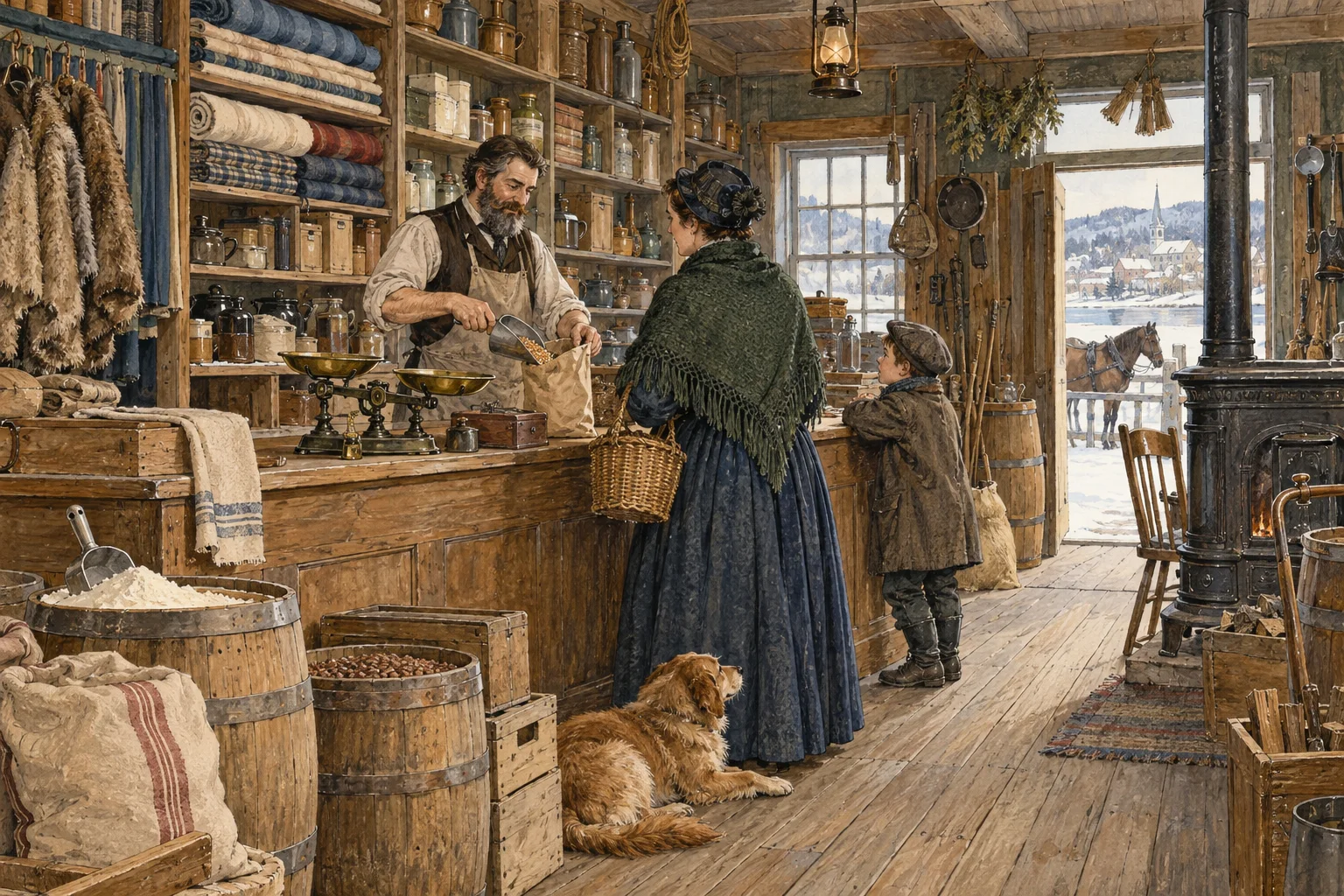
Thomas’s description is openly favourable, as local commercial sketches often were. His statement that the brothers were doing good business should be read as the author’s contemporary appraisal, not as an audited measure of profit. What can be retained securely is the named partnership, the dated transition, the street and the categories of goods. That is enough to recover a real chapter of the family’s working life without decorating it with invented prosperity.
The succession also broadens the meaning of continuity. Staying connected to the family did not necessarily mean staying on the same land or in the same occupation. In this branch, farming and retail trade belonged to successive generations of one documented line. The move into Lachute was a change of work and setting, yet Thomas still introduced the brothers through the Antrim immigrant and the Chatham farm. The old place remained part of how the new enterprise was understood. [2]
Chapter 09
Janet McFaul and the women who held the story
The immigrant’s granddaughter Janet McFaul is one of the most distinctive people in the material examined. Her Geneanet profile gives her life as 17 April 1850 to 6 September 1942. Thomas independently records her marriage to Hugh Morrow on 26 January 1874 and explains that Hugh acquired the other heirs’ claims to the McFaul homestead in 1881. That holding comprised two hundred acres; he later bought another two hundred. These are the events that make sense of the immigrant’s farm being identified through Mrs. Hugh Morrow in the merchants’ family sketch. [13] [2]
Thomas does more than name Janet as a wife. He says Hugh acknowledged her contribution to their prosperity. He also records that, in her younger years, she had visited Italy, Switzerland and other European countries, and he was impressed by what she remembered of the renowned places she had seen. No itinerary, passport or travel diary was found in this research. The surviving account does not tell us who accompanied her, how the journey was financed, or exactly when it happened. [2]

Even with those questions open, the glimpse is remarkable. A woman associated with a Chatham farm also carried memories of European places. Her life resists the temptation to make every rural ancestor’s world small and unchanging. The evidence supports travel and an informed memory of it; the personal feelings of the traveller remain hers. We need not invent a diary entry to recognise how much a genuine one would add to this history.
The adjoining Morrow narrative brings another woman into view: Hugh’s widowed mother. Thomas describes her house burning, her refuge in a barn, and her escape with a daughter who needed her care when that structure threatened to collapse. He recalls her carrying butter on the roughly eight-mile journey to Lachute and describes the severe hardship of the household. This was the family into which Janet married, not a set of experiences that can automatically be assigned to Janet or Margaret McFaul. [2]
Thomas told such lives through the moral language of his time, praising endurance, faith and industry. A modern reading can preserve the concrete events while recognising the framing. The women’s work deserves more than a supporting clause in the men’s biographies. Margaret belongs at the migration’s beginning, Mary Carpenter at the centre of a large Chatham household, and Janet at the point where the immigrant farm’s inheritance becomes visible. Future research should seek their own signatures, property interests, obituaries and correspondence, rather than treating marriage as the end of their personal histories.
Chapter 10
Ontario, Thurso, and the changing surname
William George McFaul’s branch provides the link to Wallace, Ontario. His profile gives an Irish birth in October 1817 and a death at Wallace on 10 January 1891. It associates him with Helen or Ellen Brodie and a marriage in 1838, followed by Elizabeth Aldrich in 1862. The Brodie entries appear in duplicate form in the compilation, so they should be reconciled before a definitive household is published. Thomas’s statement that the immigrant died at his son William’s Wallace home independently supports the important relationship and location, though it does not verify every detail of William’s profile. [10] [2]
Several descendants in this branch are entered under McFall. That spelling shift is part of the research landscape, not evidence that the family necessarily changed ancestry or deliberately adopted a new identity. Original signatures would be particularly useful: they can help distinguish a person’s own spelling from a minister’s, enumerator’s or later indexer’s choice. The same caution applies to middle names, which may emerge in later records without being present in the earliest ones. [10]
Matthew’s profile supplies a different direction within Quebec. It places his birth at Dalesville on 13 April 1822 and his death at Thurso on 13 March 1911. It names Matilda Elizabeth Helen Thornton and Eleanor Farlinger as spouses in successive family groups. Many of his children appear as McPhail, including James Hamilton, William George, John Finley and Samuel. These are leads from the compiled tree, not a complete set of independently checked vital records. [12]
Read together, William’s Ontario branch and Matthew’s Thurso branch show why the family should be researched across both provincial boundaries and spelling variants. A search limited to McFaul in Argenteuil would lose people who may be essential to the later story. Yet expansion needs discipline: a McFall found elsewhere in Canada should be connected through a spouse, parent, place or other specific evidence before being added to this family.
Census records offer one route toward that work. Library and Archives Canada’s guide notes that the census commonly called 1851 in Canada East and Canada West actually began in January 1852. That detail matters when comparing ages with baptism dates. An apparent one-year discrepancy may reflect the enumeration date, while a much larger difference may point to a mistaken identification. The original household image, its neighbours and its locality are more informative than a bare search-result name. [23]
Chapter 11
Beyond Argenteuil: Michigan and the Pacific
Branches reaching west
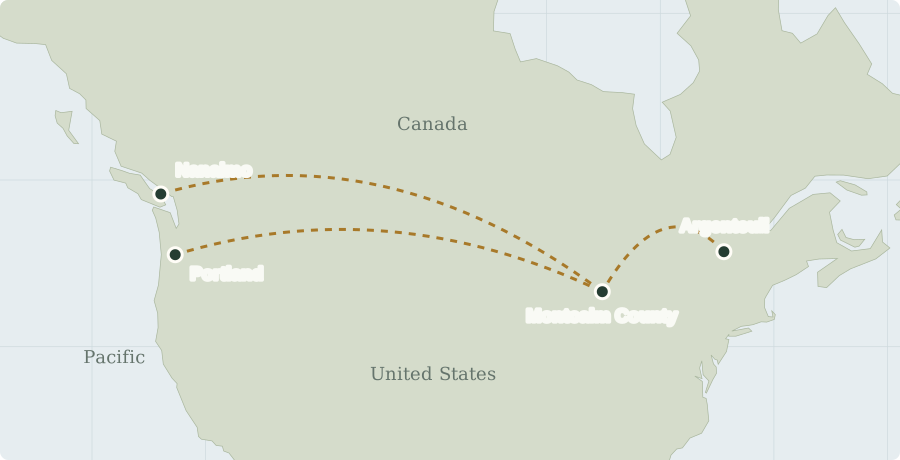
James Lawrence McFaul’s profile places his birth at Dalesville on 18 April 1820, his marriage to Agnes Scott on 18 April 1843, and his death in January 1877. Through the children assigned to that couple, the tree opens onto Michigan, Oregon and British Columbia. These later migrations are an important part of the family’s proposed history, but the individual movements still need to be rebuilt from original census, marriage and death records. [14]
One son, Thomas “Tommie” Scott McFaul, is entered as born in Chatham in 1852 and dying in Portland, Oregon, in 1931. The profile associates him with a marriage to Catharine Jane “Cassie” Wilder in Montcalm County, Michigan, in 1884, and a later marriage to Sophia Fleenor in Clark County, Washington, in 1920. These locations suggest a life extending from the Quebec settlement into the American Midwest and onward to the Pacific Northwest. They do not yet provide an uninterrupted travel chronology or explain his reasons for moving. [21]

Another son named James is entered as born at Dalesville in 1861 and dying at Nanaimo, British Columbia, in 1945. His profile gives a marriage to Ella Viola Bunce in Montcalm County, Michigan, on 2 July 1885. An Ancestry compiled profile repeats the broad outline, but agreement between two compilations does not prove that they draw on independent evidence. A conflicting 1862 birth year appears in an indexed cemetery lead. The original British Columbia death record and the Michigan marriage record should take priority over choosing between copied dates. [26] [27]
These entries make Montcalm County an especially useful place for the next stage of research. Two brothers’ reported marriages there in adjacent years may help reconstruct a shared family network. The question is not merely whether both names occur in the county. It is whether their records identify the same parents, compatible birthplaces and relevant witnesses or associates. Such details could establish how the Argenteuil branch became a cross-border family.
For the moment, the larger arc is a documented Canadian core with proposed later branches extending westward. The distinction is not a dismissal of the tree. It is a statement of what has actually been checked. Once the Michigan and Pacific records are obtained, these passages can become fuller biographies, with occupations, households and dated places of residence replacing the present outline.
Chapter 12
Reading the coat of arms
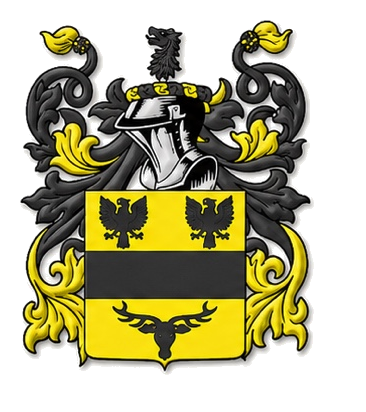
The coat of arms displayed on this website is the artwork Brian has carried forward for the McFaul family: a gold shield bearing a broad black horizontal band, two dark birds above it, and an antlered head below. A helmet, a twisted wreath, a dark animal-head crest and flowing black-and-gold ornament complete the composition. Beneath it, the chosen words Fortis et Fidelis give the website its statement of character: strong and faithful.
This guide reads that particular picture. Its descriptions are based on the visible artwork; the technical vocabulary is drawn from heraldic references. The reflections on courage, constancy and family continuity are offered as a present-day interpretation, not as a recovered explanation from the original bearer. The Heraldry Society expressly cautions that colours and charges have no fixed universal meanings. A designer may give an emblem a personal significance, but that significance does not automatically apply to another shield bearing the same emblem. [52]
The whole achievement: how the parts belong together
The complete arrangement is called an achievement of arms. The shield carries the central design; the helmet stands above it; the wreath links the helmet to the crest; and the mantling falls around the sides. In everyday speech the whole picture is often called a family crest, but crest has a more precise heraldic meaning: it is the emblem above the helmet. Here, that is the small dark animal’s head, not the gold-and-black shield or the entire illustration. [54]
Think of the design as several layers of identification. The shield provides the main pattern. The crest supplies another recognisable emblem. The surrounding equipment presents the shield in the visual language of an armoured bearer, while the motto adds words to the picture. These parts can be discussed separately without losing sight of their unity. The repeated gold and black connect the central shield with the ornament surrounding it. [54]
The shield: the field on which the story is arranged
The shield, or escutcheon, is the principal surface carrying the arms. Its background is called the field, and the devices placed upon it are charges. In this artwork the field is gold. Two birds occupy the upper area, while the stag’s head fills the lower area. The black band runs between them across the centre. These positions matter just as much to the description as the animals themselves. [54]
Heraldic directions are taken from the bearer’s viewpoint. Dexter is the bearer’s right, which is the viewer’s left; sinister is the bearer’s left, which is the viewer’s right. Chief means the upper area of the shield, and base the lower area. Saying that the birds are in chief locates them near the top; it does not mean that the gold area containing them is a separate charge called a chief. [54]
The shield’s curved sides, dark outline and shaded edges are part of this artist’s rendering. A formal heraldic description normally identifies the field and charges rather than prescribing every curve, highlight and feather. Another artist could render the same underlying design with different linework. This site preserves the existing illustration because its particular appearance is part of the family’s chosen presentation, not because every contour is a separate symbol. [54]
Gold: the heraldic metal Or
The yellow-gold field is described in heraldry as Or. Gold and silver belong to the category called metals; black, red, blue and other conventional hues belong to the colours. Yellow can represent gold without implying that the physical object was gilded. The exact yellow on a screen is an artistic choice rather than a secret code or a prescribed modern colour value. [53] [52]
Visually, the gold field gives the black charges exceptional clarity. The birds, band and antlered head are readable because their silhouettes contrast with their background. This also accords with the usual heraldic convention of placing a colour on a metal rather than a colour on another colour. In this design, black is set against gold. [53]
As a present-day family interpretation, gold can be read as warmth, generosity and the value placed on what is handed down. That is an invitation to meaning, not proof that the original designer intended those particular virtues. It certainly does not establish that an ancestor possessed great wealth, held royal favour or earned an award for generosity. The colour is securely identifiable; the original reason for choosing it remains unknown.
Black: the heraldic colour Sable
The principal dark elements are Sable, the heraldic term for black. They include the central band, the two birds and the stag’s head. Black also appears in the wreath, crest and mantling. Grey highlights in the illustration give these elements depth; they do not necessarily introduce an additional heraldic tincture. The description concerns the represented colour, not every shaded pixel. [54]
For this family presentation, black can suggest steadiness, resolve and an ability to endure. Paired with gold, it creates a restrained, forceful identity. Those are our interpretive associations, however, and should not be mistaken for a universal heraldic dictionary. In particular, black does not by itself prove mourning for a particular ancestor, participation in a battle, or a historical vow. No document identifying such an event for this artwork has been found.
The central band: a fess
The broad horizontal band across the middle of the shield is a fess. Fox-Davies describes the fess as one of heraldry’s principal geometric charges, commonly grouped among the ordinaries. Here it is straight-edged and uncharged: there are no further emblems placed on the band itself. It is distinct from a pale, which runs vertically, and a bend, which runs diagonally. [54]
The design is best read visually as a gold field with a black band laid across it, rather than three unrelated horizontal fields. The gold above and below remains part of the same background. The fess separates the two upper birds from the lower stag’s head and gives the composition its strong centre of gravity. Its broad simplicity also balances the much more detailed animals and surrounding ornament.
A fitting modern reading is continuity: something firm running through the centre while different elements occupy their own places around it. In a family history, that can suggest a bond between generations or steadfastness amid movement. It should not be presented as a documented McFaul meaning. Nor does the presence of a fess establish that an ancestor received a military belt of honour; explanations of that kind require evidence beyond the shape itself.
The two birds: apparently eagles displayed
The two black birds are shown frontally, with wings spread, legs visible below and their heads turned in profile. Their stylised form is consistent with heraldic eagles displayed. Displayed describes an attitude—the arrangement of the body and wings—not a species in itself. An original blazon would confirm the intended bird and any required details of its beak, claws or wing position. [54]
They are two separate single-headed birds. They should not be confused with a double-headed eagle, which is one bird with two heads. Their matching placement on either side of the upper shield gives rhythm and balance. The number two is part of the design, but the image provides no evidence that the birds represent two brothers, two countries, two branches of the family or two victories.
Fox-Davies discusses the eagle’s long history in armorial and imperial imagery. That wider history explains why the form can feel powerful and commanding, but it does not connect these McFauls to an empire or imperial dynasty. A symbol can be widely shared without its bearers sharing a genealogy. [54]
Within the present family reading, the birds can evoke alertness, courage and the ability to look beyond an immediate horizon. Their outspread wings lend themselves to an image of readiness. That is a poetic interpretation appropriate to a family whose documented and proposed branches crossed several regions; it is not evidence that the birds were originally chosen to commemorate those migrations.
The stag’s head: antlers, symmetry and a direct gaze
Below the band appears a dark antlered head facing the viewer. The antlers branch outward, the ears project to either side, and the face narrows towards the muzzle. The image is consistent with a stag’s head cabossed, also spelled caboshed: a head shown face-on without a length of neck extending beneath it. Fox-Davies distinguishes this from heads shown in profile or with a more substantial neck. [54]
This is a head rather than a whole standing or running stag. It should therefore not be described as a stag trippant, courant or at gaze, terms belonging to particular representations of the animal. The antlers themselves are sometimes called attires in heraldic language. Their colour, if different from the head, can be separately specified in a blazon; in this artwork both read as black. The small antler branches should not be counted as generations, children or honours without documentary support. [54]
The direct frontal pose makes this the lower shield’s focal point. It offers a different kind of presence from the spreading wings above: the birds suggest outward reach, while the antlered head faces the observer squarely. For a modern family interpretation, the stag can suggest dignity, attentiveness and a connection with the natural world. Such a reading need not become a claim that the family owned a deer forest, served as royal huntsmen or descended from a particular Highland chief.
There is no cross between the antlers in this illustration. It would therefore be speculative to identify the head as a specific religious scene involving a stag with a miraculous cross. The useful discipline is to read the image that is present, rather than adding an attractive story from another tradition.
The helmet: the setting for the crest
Above the shield sits a steel-coloured helmet, turned towards the viewer’s left. Its visor, plates and highlights give the achievement an armoured character. The helmet is part of heraldry’s inheritance from martial and tournament equipment; in this illustration it also forms the structural link between the shield below and the crest above. [54]
Heraldic conventions can associate particular helmet forms and positions with rank. A modern drawing alone, especially one whose original grant has not been located, is not a sound basis for assigning a title to the family. The visible helmet does not prove knighthood, military service, participation in the Crusades or noble descent. Its detailed metalwork can be appreciated as part of the design without converting it into an ancestor’s service record. [53]
The wreath: the torse of gold and black
Immediately above the helmet is a twisted band alternating gold and black. This is the wreath or torse. It provides the visual base on which the crest rests and repeats the principal tinctures of the shield. The repetition makes the upper and lower portions of the achievement feel like one design rather than several independent pictures. [54]
The torse belongs to the conventional equipment of heraldry. It should not be read here as a royal crown, a necklace of medals or a tally of ancestral generations. Its individual twists are not evidence of separate honours. Their main role in this composition is to join the helmet and crest while carrying the black-and-gold colours upward. [54]
The animal-head crest: a detail still to identify securely
At the very top is a small dark animal’s head in profile, facing towards the viewer’s left. It has an open mouth, a projecting muzzle and a jagged or shaggy outline around the neck. This is the crest in the strict heraldic sense. It is separate from the stag’s head on the shield: they occupy different positions and are not the same emblem repeated.
The surviving illustration is too small to identify this animal confidently. It has a wolf-like silhouette, but the details needed to distinguish a wolf, boar, bear or another stylised beast are not secure enough to support a formal identification. Enlarging the existing pixels cannot recover features that were never clearly recorded. For that reason, this guide calls it an animal-head crest rather than supplying a definite species and an invented family story.
The irregular lower edge may represent an erased head, the heraldic term for a head shown with a ragged separation rather than a clean cut. A clean-cut termination would normally be described as couped. That distinction concerns the way a charge is drawn; it is not evidence that the bearer literally killed or beheaded the animal. The original blazon or a sharper early image is needed to settle both the creature and the treatment of its neck. [54]
The mantling: flowing cloth, not a botanical emblem
The elaborate gold-and-black forms on either side are mantling. Their curled and deeply cut shapes resemble leaves, but their heraldic identity is stylised cloth associated with the helmet. Over time, artists developed this cloth into an expansive decorative surround. Its folds can be drawn with considerable freedom, which helps explain the mixture of leaf-like points, rolled ends and sweeping curves in this image. [54]
Gold appears as turned-back surfaces against the black portions, echoing the colours of the shield and torse. Without the original blazon, it is better to describe the visible black-and-gold mantling than insist upon the precise historical wording of its outside and lining. The decoration gives the otherwise compact shield movement and breadth.
These forms should not be separately identified as oak, laurel or acanthus charges merely because they resemble foliage. Nor are they supporters: supporters would be distinct figures, often animals or people, flanking the shield. No such separate figures are shown here. The ornament’s jagged edges also do not document battle damage to a particular McFaul ancestor’s equipment. They belong to the artistic treatment of the mantling. [54]
Fortis et Fidelis: strength joined to faithfulness
Fortis et Fidelis is rendered here as Strong and faithful. Fortis can carry the sense of strength, bravery or courage; et means and; fidelis means faithful, loyal or trustworthy. Brave and faithful is therefore another natural English rendering. The wording chosen for this website is Fortis et Fidelis, and it should not be silently replaced by a similar motto containing a different Latin word.
As a present-day statement for the family website, the pairing is more interesting than strength alone. Fortis speaks to the ability to endure and act with courage. Fidelis asks what that strength serves: keeping faith, maintaining trust and remaining true to people and commitments. Read together, the words suggest character expressed through conduct. Strength makes a promise possible to keep; faithfulness supplies the reason to keep it.
Brian requested the phrase for this site. Its use here records that choice; research has not yet established when an earlier bearer first used it with this particular shield and crest. The motto is therefore not presented as an authenticated medieval quotation or as proof of a connection to another family using similar words.
A cautious description in heraldic language
If the birds are confirmed as eagles, a provisional description of the shield would be: Or, a fess between two eagles displayed in chief and a stag’s head cabossed in base, all Sable. In ordinary English: a gold shield with a black horizontal band between two black spread-winged eagles above and a black, front-facing stag’s head below. This wording is a reading of the illustration, not a quotation from a grant or an authenticated entry in an armorial register. [54]
The crest should remain outside that provisional identification until its animal is established. No supporter, coronet, badge of an order or other additional distinction should be supplied from imagination. The next decisive find would be an original blazon, an early named armorial entry, a seal, or a dated family document showing the same design. Such a source could establish which details are essential and might explain why they were chosen.
Until then, the artwork can be read with both affection and precision. Its visible structure is strong: dark charges against gold, a steady central band, spreading wings above, the stag’s direct gaze below, and a crest rising over the helmet. Its chosen motto gives that visual strength a human direction. As a contemporary interpretation for this website, the whole may be read as courage held to a standard of loyalty—a family identity expressed through Fortis et Fidelis.
Chapter 13
Inheritance, memory, and the next chapter
The best-supported story is already rich: an Antrim origin remembered by an independent nineteenth-century author; a Chatham farm carried through a granddaughter’s household; a later generation working land at Brownsburg; and two brothers establishing a Lachute partnership in the 1890s. Beside it are promising older clues and later geographical extensions whose documentary connections remain to be completed. The whole need not be flattened into either absolute certainty or complete doubt. [2]
Heraldry deserves the same care. The College of Arms explains that arms belong to particular individuals and families under the relevant rules of descent, rather than automatically to everyone sharing a surname. No armorial entitlement for this branch has been established here. A family may preserve a treasured crest image as part of its own story, but the website should label its provenance honestly and should not turn a commercial surname illustration into proof of noble descent. [28]
The highest-value next research is close to the people, not farther back in legend. Obtain the reported 1822 baptism entry; retrieve Archibald’s land-grant papers; reconstruct the Chatham children from church records; inspect William’s Wallace household and the immigrant’s death or burial evidence; and connect Brian to one of these branches through a documented sequence of parents and grandparents. After that, the Ballintoy and Scottish questions can be approached with a firmer Canadian identification in hand. [4] [24] [29]
This edition preserves uncertainty where it belongs, but it is not an empty history waiting for certainty to arrive. There were farms, inheritances, marriages, a store on John Street, a remembered prayer, and a woman who came home with knowledge of Italy and Switzerland. Those details give the McFaul past texture and individuality. The task now is to keep their names attached to their own lives, and to carry the record forward with the same care with which a family carries anything worth keeping.
Chapter 14
The family today
His dad is the eldest
The story continues in a large living family. Brian McFaul’s father is the eldest of seven children: his father and six siblings make up that generation of the McFaul family. Brian also reports sixteen cousins bearing the McFaul name. Some of those cousins have children of their own, carrying the story into a further generation. These details are Brian’s contribution to this edition; names, individual relationships and connections to the historical branches will be filled in later.
This next chapter will bring together the people behind those numbers: family photographs, memories, places lived, and the records that connect one generation to another. For now, no cousin has been assigned to an aunt or uncle, and no missing parent–child relationship has been guessed. The historical line and the present-day family remain to be joined with evidence.
As the gaps are filled, each branch can have its own account within the family history, with the same table of contents making it easy to find. Names and stories of living relatives can be added when they are ready to be shared. A family history grows best when the people whose lives it records have a hand in telling it.
Roots & branches
The illustrated family tree
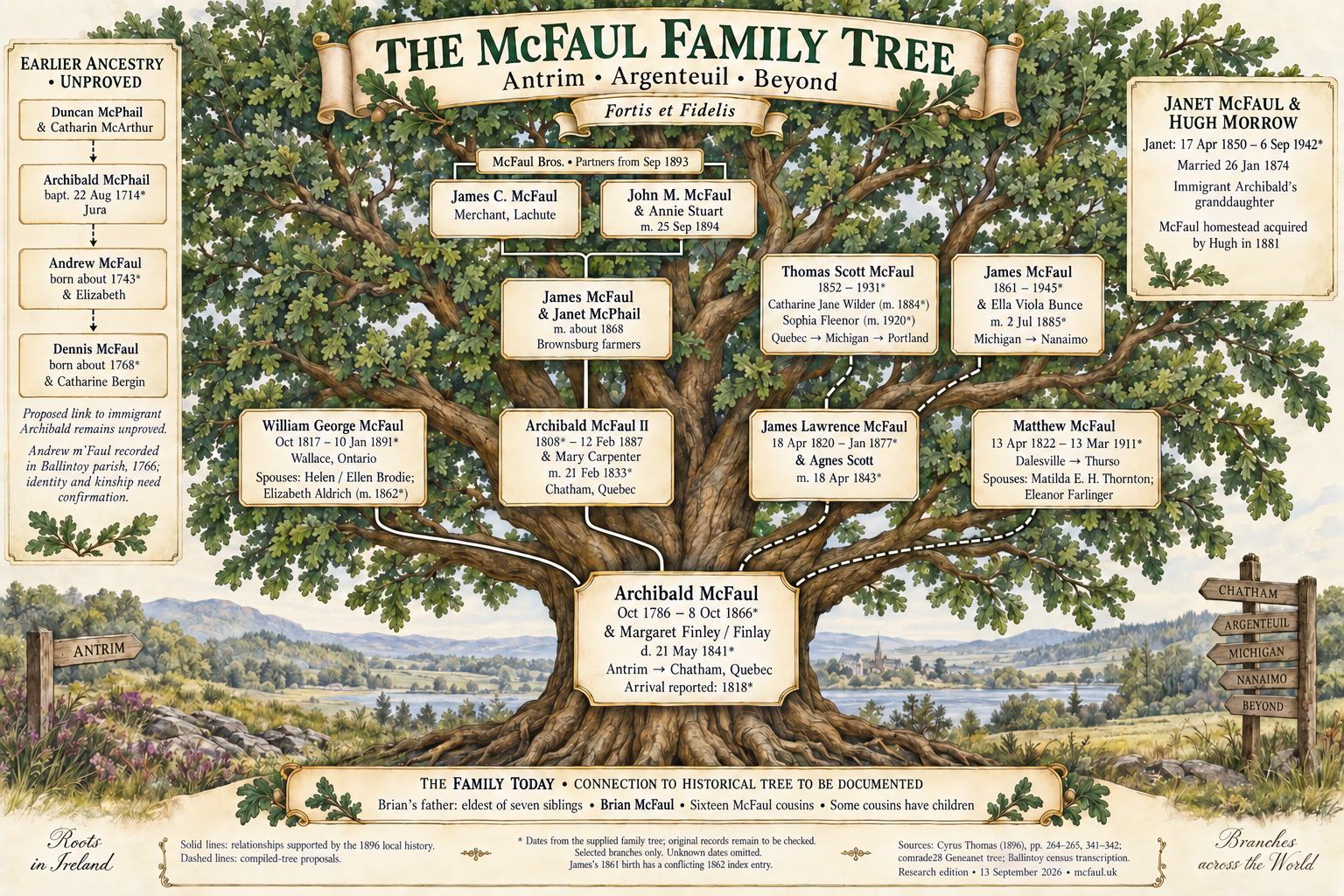
Selected researched branches, not a complete genealogy. Solid connections represent support in the 1896 history; dashed connections indicate compiled-tree proposals. Earlier ancestry and the connection to Brian’s generation remain unproved. The accompanying chapters and evidence ledger provide the source details.
A documented framework
Four generations in the 1896 account
Cyrus Thomas connects these generations in his sketch of McFaul Bros. This is the clearest independent narrative framework found; it is not yet a complete vital-record proof or Brian’s verified direct line. [2]
- Generation 1Archibald McFaul
From County Antrim; settled in Chatham; died at son William’s home in Wallace.
- Generation 2Archibald McFaul & Mary Carpenter
Chatham farm. Mary was a daughter of James Carpenter. Archibald died 12 February 1887.
- Generation 3James McFaul & Janet McPhail
Brownsburg farming household; parents of the merchants.
- Generation 4James C. & John M. McFaul
Brothers and partners in McFaul Bros., John Street, Lachute, from 1893.
Mary Carpenter, Janet McPhail and Janet McFaul Morrow are distinct people. Repeated names and variant spellings require particular care.
Dates & places
A family chronology
| Date | Event | Evidence |
|---|---|---|
| 1766 | Andrew m’Faul listed at Glenstaghey/Glenstaghie, Ballintoy. | Transcription; relationship unproved [5] |
| 1818 | Archibald, Margaret and five children reportedly arrive in Canada. | Family notes; arrival record outstanding [4] |
| 22 Sep 1822 | Reported joint baptism of James and Matthew in Chatham. | Family notes; register outstanding [4] |
| 21 Feb 1833 | Archibald II and Mary Carpenter reportedly marry at St. Andrews. | Tree date; spouse independently named by Thomas [11] |
| 1843 | An elderly McFaul appears in the Dalesville revival account. | Church chronology and King’s recollection [20] |
| 8 Oct 1866 | Death date assigned to the immigrant Archibald. | Tree date; Thomas independently places death at William’s Wallace home [4] |
| 26 Jan 1874 | Janet McFaul marries Hugh Morrow. | Thomas, p. 342 [2] |
| 1881 | Hugh Morrow buys the other heirs’ claims to the McFaul homestead. | Thomas, p. 342 [2] |
| 12 Feb 1887 | Death of Archibald, husband of Mary Carpenter. | Thomas, p. 265; tree agrees [2] |
| Sep 1891 | James C. McFaul enters partnership with Robert Banford in Lachute. | Thomas, p. 265 [2] |
| Sep 1893 | James C. buys out Banford and partners with brother John M. | Thomas, p. 265 [2] |
| 1896 | Cyrus Thomas publishes his account of the family and district. | Book publication [2] |
| 1931 / 1945 | Tree places Thomas Scott’s death in Portland and James’s death in Nanaimo. | Later branches; original records outstanding [21] |
The research ledger
What the evidence supports
The categories below describe the evidence actually examined. A record named in somebody else’s tree has not been treated as an original record inspected here.
Antrim immigrant → Archibald and Mary Carpenter → James and Janet McPhail → McFaul Bros.Independent narrative support
Thomas, 1896, pp. 264–265, gives this four-generation sequence. It is a retrospective local account, not a complete set of vital records. [2]
Arrival in 1818 with Margaret and five Irish-born childrenFamily research account
Reproduced Forde notes in the immigrant’s profile. No passenger manifest, vessel or landing record inspected. [4]
Immigrant had four sons and three daughtersUnresolved child list
Thomas and the narrative notes fit seven children; eleven linked children appear in the current profile. Do not publish all eleven as established siblings. [2] [4]
James and Matthew baptised together, 22 September 1822High-priority original to retrieve
Family notes name Rev. Archibald Henderson and Chatham residence. Register image not inspected. [4]
Janet McFaul married Hugh Morrow on 26 January 1874Independent narrative support
Thomas p. 342 also describes the 1881 consolidation of the McFaul homestead and Janet’s European travel. [2] [13]
Andrew m’Faul at Glenstaghey/Glenstaghie in 1766Transcription visually verified
Macafee PDF p. 8, record 70, referring to original p. 1; PRONI T3901/2. Does not name wife, child Dennis or birthplace. [5] [6]
Dennis and Catharine Bergin were the immigrant’s parentsUnproved; conflicting attachments
Tree relationship only. Laois Catholic registers lack a demonstrated connection to Ballintoy; late child dates conflict with the proposed maternal birth year. [7] [9] [16] [17] [18]
Jura baptism in 1714 establishes this family’s Scottish originUnproved connection
Indexed baptism in compiled profile; no original inspected and no evidence linking that child to Andrew in Antrim. [8]
Archibald was a military pensioner who received a grantFamily tradition and archival lead
Retrieve Letters Patent Book W, Grants p. 75; county index vol. 1 p. 38. Dennis’s WO 25/499 reference is not proof of Archibald’s service. [4] [7] [24] [25]
The elderly McFaul in the revival account was ArchibaldPlausible, not identified
King’s recollection does not supply a forename. Modern church account depends on the older story. [2] [20]
James’s 1861 birth and later Nanaimo deathCompiled lead; date conflict
Tree and compiled Ancestry profile agree broadly; cemetery index lead uses 1862. Retrieve original marriage and death records. [26] [27] [36]
Every attached index hit belongs to the named ancestorRejected method
Some profiles attach geographically or chronologically discordant census, military and marriage entries. Each requires a separate identity comparison; an attachment alone is not verification. [4] [6] [10] [15]
The next records to obtain
- Connect Brian to this historical tree using a documented sequence of parents and grandparents.
- Retrieve the reported Chatham baptism of James and Matthew, 22 September 1822.
- Inspect Archibald’s grant references: Letters Patent Book W, Grants p. 75; county index vol. 1 p. 38.
- Reconstruct the immigrant’s children and reconcile the seven-child narrative with eleven linked entries.
- Verify Wallace census, death and burial evidence, then the Michigan and British Columbia records.
- Inspect PRONI T3901/2 and WO 25/499 before extending the pedigree through Andrew and Dennis to Jura.
The open notebook
Sources & research links
All 58 links below are classified. The main narrative cites the sources it uses; additional leads are retained for further work, including namesakes that have not been connected to this family. Some genealogy pages require an account.
Research date: 11 September 2026. Original passenger, baptism, military, grant and later vital-record images remain outstanding where stated. The Ballintoy transcription was visually checked; its original manuscript was not. No DNA relationship or entitlement to arms has been established.
- McFaul surname index in the supplied comrade28 family tree
User-supplied compiled genealogy
Starting tree; public index and selected profiles inspected. Not all attached record images were accessible.
Return to the history ↑ - Cyrus Thomas, History of the counties of Argenteuil, Que., and Prescott, Ont. (1896)
Public-domain local history; independently consulted
John Lovell & Son, Montreal. Especially pp. 264–265 (McFaul Bros.), 341–342 (Morrow), 350 and following (King recollections), and 366 (McFaul’s Flats). OCR consulted and key passages checked in context. Retrospective for early settlement; near-contemporary for the merchants.
Return to the history ↑ - Geneanet surname reference: McFaul
Surname reference
Attributes its entry to Dictionary of American Family Names, second edition, Patrick Hanks, 2022. Etymology, not proof of this family’s descent.
Return to the history ↑ - Archibald Floyd McFaul — profile and family research notes
Compiled genealogy and attributed family tradition
Source for the reported 1818 arrival, 1822 baptism, disability story and archival leads. Birthplace passages and linked child count conflict.
Return to the history ↑ - W. Macafee, 1766 Religious Census for Ballintoy parish — surname transcription
Modern transcription of archival record
Dated 18 October 2012. PRONI T3901/2. PDF p. 8 visually checked: record 70, Andrew m’Faul, Glenstaghey [Glenstaghie], Protestant, original p. 1. Original manuscript not inspected.
Return to the history ↑ - Andrew McFaul — proposed Ballintoy ancestor
Compiled genealogy; relationship unproved
About 1743; proposed spouse Elizabeth and son Dennis. Some attached records require chronological identity checks.
Return to the history ↑ - Dennis McFaul — proposed father and military reference
Compiled genealogy; original required
WO 25/499, 84th Foot, 1 May 1794 appears among sources. Not independently matched to an original service entry.
Return to the history ↑ - Archibald McPhail — proposed Jura generation
Compiled baptism lead
Reported 22 August 1714 baptism, parents Duncan McPhail and Catharin McArthur. Link to Antrim Andrew is not established.
Return to the history ↑ - Catharine Bergin — proposed spouse of Dennis
Compiled genealogy with conflicting chronology
About 1767 birth; late child dates and Laois register attachments require reconstruction.
Return to the history ↑ - William George McFaul — Wallace branch
Compiled genealogy
Brodie spouse duplication and geographically discordant attached indexes need separate checks.
Return to the history ↑ - Archibald II McFaul and Mary Carpenter
Compiled genealogy partly corroborated by Thomas
Marriage date is tree-derived. Thomas independently names Mary’s father and gives Archibald’s 12 February 1887 death.
Return to the history ↑ - Matthew McFaul — Dalesville to Thurso
Compiled genealogy
Later descendants often entered as McPhail; vital-record images not independently inspected.
Return to the history ↑ - Janet McFaul, wife of Hugh Morrow
Compiled genealogy partly corroborated by Thomas
Tree life dates; marriage, homestead and travel independently described in the 1896 book.
Return to the history ↑ - James Lawrence McFaul and Agnes Scott
Compiled genealogy
Starting point for proposed Michigan and Pacific branches; full household not reconstructed from original records.
Return to the history ↑ - Margaret Finley — immigrant spouse
Compiled genealogy with disputed attachments
Marriage chronology and attached McDonell marriage need identity checks.
Return to the history ↑ - National Library of Ireland: Offerlane register, microfilm 05018/01
Official archive catalogue
County Laois, Diocese of Ossory. Catalogue confirms location and coverage; individual baptism identities not verified.
Return to the history ↑ - National Library of Ireland: Rathdowney parish registers
Official archive catalogue
County Laois; includes microfilm 05013/08. Used to assess geography of attached Bergin sources.
Return to the history ↑ - National Library of Ireland: Aghaboe register, microfilm 05012/02
Official archive catalogue
County Laois; nineteenth-century marriages and baptisms. Does not itself establish the Antrim relationship.
Return to the history ↑ - Parks Canada: Carillon Canal history
Official regional history
Canal-building chronology and timber-trade context; not evidence of the family’s route or occupation.
Return to the history ↑ - Dalesville Baptist Church: history
Institutional history drawing on earlier recollections
Places the second revival in 1843. The elderly McFaul episode follows King’s account and is not an independent second witness.
Return to the history ↑ - Thomas Tommie Scott McFaul — Michigan and Oregon branch
Compiled genealogy
Reported marriages in Michigan and Washington and death in Portland. County inconsistencies not adopted.
Return to the history ↑ - Clan MacPhail: surname spellings
Clan society cultural reference
Spelling association only; no entitlement to arms or proved chiefly descent follows.
Return to the history ↑ - Library and Archives Canada: about the 1851 census
Official research guide
Explains the January 1852 enumeration start for Canada East and Canada West.
Return to the history ↑ - Library and Archives Canada: Lower Canada land petitions, 1764–1841
Official research guide
Route to petition papers; not the immigrant’s actual grant. The specific patent references remain leads from his profile.
Return to the history ↑ - The National Archives: British Army soldiers up to 1913
Official research guide
For pursuing service, discharge and pension evidence; does not confirm the identity in the tree’s WO 25 reference.
Return to the history ↑ - James McFaul — Dalesville, Michigan and Nanaimo
Compiled genealogy
1861–1945 profile; original Michigan marriage and British Columbia death records remain to be checked.
Return to the history ↑ - Ancestry compiled profile: James McFaul
Corroborating compilation, not independent proof
Repeats the Dalesville–Nanaimo outline. Underlying original records not examined.
Return to the history ↑ - College of Arms
Official heraldic authority
General guidance on arms and entitlement. No grant for this McFaul branch was identified.
Return to the history ↑ - Public Record Office of Northern Ireland
Official archive
Next step for original T3901/2, church, estate and related records.
Return to the history ↑ - 1896 Argenteuil and Prescott history — searchable OCR text
Companion access link
Public-domain text consulted locally; OCR may misread spelling and page numbers.
Return to the history ↑ - Library and Archives Canada: Census Search
Further research portal
Portal identified; no original household image is represented as verified in this edition.
Return to the history ↑ - Lower Canada land petitions: search page
Further research portal
Use surname variants, township and linked relatives; a search hit requires original-document inspection.
Return to the history ↑ - The National Archives: muster rolls and pay lists, 1730–1898
Further research guide
Useful companion to the proposed Dennis military lead.
Return to the history ↑ - FamilySearch compiled profile: Thomas McFaul, 1843–1914
Additional branch lead
Names Archibald and Mary Carpenter as parents; Susan McAslin as spouse. Not incorporated as a verified biography.
Return to the history ↑ - Ancestry compiled profile: Archibald III McFaul
Additional branch lead
Proposed 1839–1900 son of Archibald and Mary Carpenter. Parent birth-year discrepancy requires checking.
Return to the history ↑ - Ancestry cemetery-index search lead: James McFall/McFaul
Unresolved search-index lead
Search result surfaced a Nanaimo James with an 1862 birth year. Dynamic search URL, not a permanent memorial citation; original memorial and vital record not verified.
Return to the history ↑ - Diana DeBrohun, Discovering Arthur McFalls’ Ancestors (2024)
Separate-family research lead
Discusses surname and DNA research and labels a portrait connection as possible. No DNA connection to Brian is established; not used to extend this pedigree.
Return to the history ↑ - Prince Edward County: archaeological and cultural heritage report
Namesake exclusion lead
Contains a Wellington Archibald associated with an 1815 arrival. Not merged with the Dalesville immigrant on a shared name.
Return to the history ↑ - Argenteuil Hospital Foundation: Ed McFaul Foundation support (2021)
Modern regional namesake lead
Institutional evidence of the name in regional philanthropy; genealogical connection not established.
Return to the history ↑ - The Review: Ed McFaul Foundation donation (2019)
Modern regional namesake lead
Additional foundation reporting; not evidence of descent from the immigrant.
Return to the history ↑ - MRC d’Argenteuil: built heritage booklet
Local heritage lead
McFaul-associated houses on Grace Street in Lachute merit property research. Ownership chains not established here.
Return to the history ↑ - Wentworth municipal road map
Place-name lead
Chemin McFaul is a geographical lead; naming origin and relationship unverified.
Return to the history ↑ - Ancestry surname reference: McFaull
Additional surname reference
Variant spelling and Gaelic derivation; not a genealogical record.
Return to the history ↑ - Ulster Historical Foundation: Doagh gravestone inscriptions
Other McFaul locality lead
Randal McFaul of Holestone appears in the material. No connection to the Ballintoy–Chatham family established.
Return to the history ↑ - Glens of Antrim Historical Society: the Glassmullan McDonnells
Other Antrim surname lead
Angus McFaul appears in transcribed rental material. Not attached to this pedigree.
Return to the history ↑ - Rathlin Island family-history research: genealogy
Independent researcher’s leads
McFall/McFaul/McPhail variant searches and local families; relationship to this tree unproved.
Return to the history ↑ - Rathlin Island research: McFaul Catholic baptisms in Scotland
Separate records lead
Potential spelling and locality comparisons, not evidence for the proposed Jura ancestry.
Return to the history ↑ - ScotlandsPeople: tracing Scottish ancestors, parish-record guidance
Official research guidance
For pursuing the indexed Jura baptism in original parish material.
Return to the history ↑ - ScotlandsPeople: record coverage guidance
Official research guidance
Companion overview of available historical records.
Return to the history ↑ - Library and Archives Canada: Lower Canada land records series
Official series-level catalogue
Series description, not an individual McFaul grant.
Return to the history ↑ - Parks Canada: Carillon Canal management plan, historical context
Official regional background
Additional canal chronology. Not an ancestor-specific source.
Return to the history ↑ - The Heraldry Society: Frequently Asked Questions
Specialist heraldic reference
Used for the absence of universal symbolic meanings and artistic treatment of tinctures. Does not authenticate this McFaul artwork or its entitlement.
Return to the history ↑ - Court of the Lord Lyon: Blazoning — the language of heraldry
Official heraldic educational reference
Definitions of Or and Sable, metal/colour contrast and helmet conventions. No specific McFaul grant is identified.
Return to the history ↑ - Arthur Charles Fox-Davies, A Complete Guide to Heraldry (1909)
Public-domain historical heraldic reference
Technical descriptions of the achievement, fess, eagles displayed, stag heads, crests, helmets, wreaths and mantling. Its general examples do not establish the origin of this particular design.
Return to the history ↑ - Natural Earth: public-domain map data
Geographic base map
Simplified 1:110 million land polygons used for the Atlantic and western North America maps. Place markers are approximate; connecting lines are explanatory, not travel records.
Return to the history ↑ - Natural Earth: 1:110 million land polygons
Geographic source dataset
Source for the two locally rendered overview maps.
Return to the history ↑ - OpenStreetMap: map contributors and licensing
Modern regional map
Interactive maps of County Antrim, Ballintoy and the Ottawa Valley. Modern geography does not establish historical farm boundaries.
Return to the history ↑ - Townlands.ie: Ballintoy civil parish, County Antrim
Geographic reference
Parish reference linked from the introductory map. The village marker is not an identified ancestral home.
Return to the history ↑